
What a tipster subscription really costs your bankroll
Paid betting tips look cheap next to the profit they promise. Whether a tipster subscription is worth it depends on one number that no sales page prints.

Pros
- Closing line value shown on every record.
- Every tipster's history readable without an account.
- The offers page states an expected return in plain numbers, which most services never do.
Cons
- The middle plan needs 4,750 euros of turnover a month before the fee earns anything.
- All three plans advertise the same 4% return, so the higher price buys more tipsters, not a better edge.
- Two of the three prices are discounts: Pro is cut from 199.95 euros and Investor from 333.28.
- The site says you need suitable capital and never says how much.
The fee is not the cost
Most readers judge paid betting tips the way they judge a streaming service. They ask whether ninety euros a month is affordable.
A betting subscription works differently. A tipster does not hand you profit. It gives you a small edge on the money you put through the market. A small edge on small stakes earns very little, and the fee stays the same.
So the useful question is not whether you can afford the fee. It is how much you would have to bet each month before the fee makes sense.
One formula decides it
Paid services describe their expected return as ROI on staked volume. Some call it yield. It means profit as a share of everything you put on, not of your betting bank.
The formula follows from that.
Monthly turnover needed to break even = the fee divided by the expected ROI.
At an expected 4% return, a fee of 100 euros needs 2,500 euros of turnover in a month before you are level. Level, not in profit.
Break-even turnover is an average, not a schedule. A service with a real 4% edge still has losing months. Reaching the turnover does not mean the month ends level. It means the fee is fair over a long run.
Every paid service runs on this arithmetic, whether or not it publishes the sum.
What real subscription prices look like
Bet2Invest is a European tipster subscription platform. Its offers page shows three monthly plans, and all three advertise about 4% ROI on staked volume.
| Plan | Price a month | Turnover to break even | Bets at 50 euros each | Turnover if the return is 2% |
|---|---|---|---|---|
| Beginner | 94.95 euros | about 2,400 euros | 48 | about 4,800 euros |
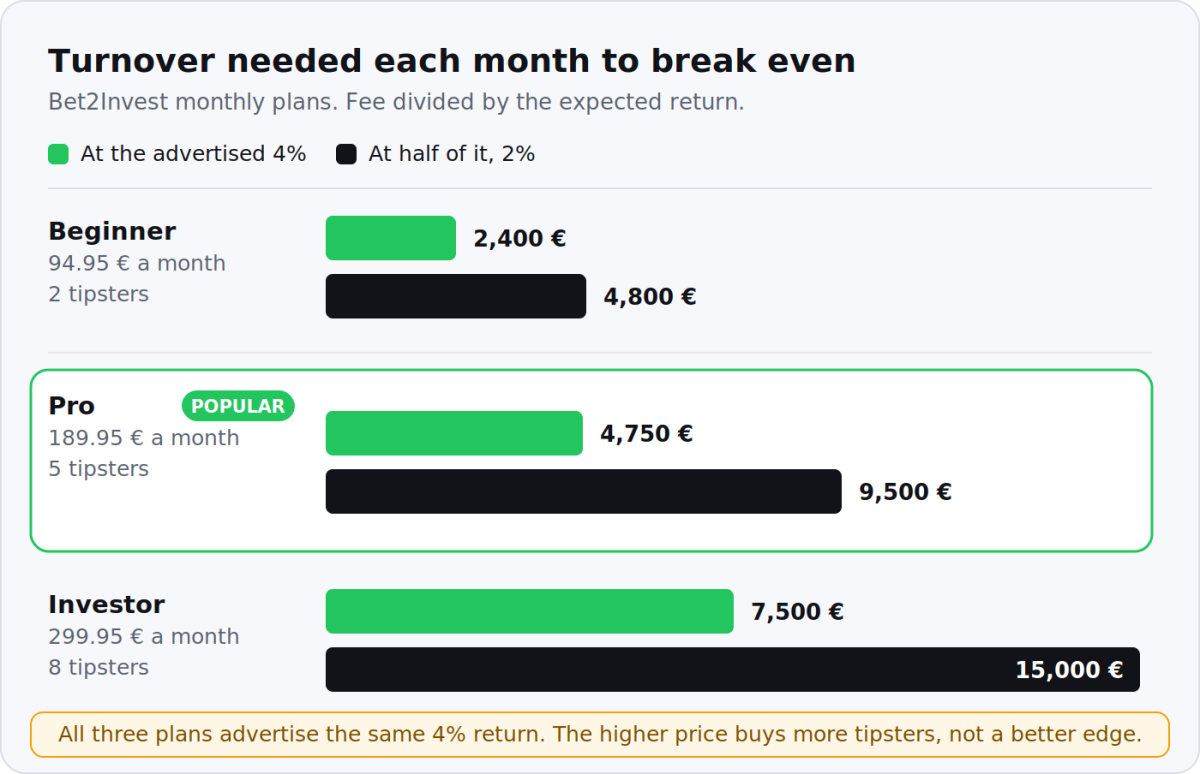
| Pro | 189.95 euros | about 4,750 euros | 95 | about 9,500 euros |
| Investor | 299.95 euros | about 7,500 euros | 150 | about 15,000 euros |
Two of those prices are already discounted. Pro is cut from 199.95 euros and Investor from 333.28 euros. Check what you will be charged once the discount ends.
Read the bets column first. On the Pro plan you place ninety-five settled bets in a month, at fifty euros a bet, and you finish level.
Stake 5,000 euros across that month and 4% gives you 200 euros. The plan costs 189.95. You keep about ten euros for the month.
A losing month costs you twice
The fee is charged whether the month goes well or badly.
Turn over 4,750 euros on the Pro plan and lose 4% instead of winning it. The bets take 190 euros from you. The subscription takes another 190. The month is about 380 euros down, on the exact turnover that was supposed to break even.
That is normal, and it is not a sign of a bad service. It is the reason the fee has to look small next to your stakes, not small next to your salary.
A bigger plan is not simply a bigger bill
Compare the three plans. The advertised return does not change. All three say about 4%. What rises with the price is the number of tipsters picked for you: two, five and eight. What falls is how wildly your results swing from month to month.
Spreading your money over more tipsters is a fair thing to sell. Good runs and bad runs cancel each other out more smoothly. That has real value for anyone who cannot sit through a long run of losses.
It is still not what most buyers think they are buying. Paying three times more does not triple the return. Bet2Invest says on its own page that you need suitable capital to make a subscription profitable. It puts no number on that.
The cheaper plan is not the safe choice by default either. Fewer tipsters means fewer bets, and fewer bets have to be bigger to reach the same turnover.
Can the plan issue enough bets
The table assumes you can find the turnover. On a small plan you may not be able to.
Say each selected tipster sends about twenty bets a month. Two tipsters give you forty bets, so 2,400 euros of turnover means 60 euros a bet. Eight tipsters give you 160 bets, and 7,500 euros of turnover needs only about 47 euros a bet.
The cheapest plan can therefore demand the largest stake per bet. Count the bets a plan can deliver before you judge its price.
The advertised ROI is not yours yet
The formula uses expected ROI, and that figure belongs to the service, not to you.
Your version is lower, for reasons that have nothing to do with the tipster's skill. You will take a shorter price than the record shows, because a published tip moves the market. Your account may be limited on exactly the markets that made the record work.
Halve the expected return and the break-even doubles. At 2% instead of 4%, the Pro plan needs 9,500 euros of turnover a month rather than 4,750. That is the last column of the table.
Run the formula twice. Once with the number they advertise, once with half of it.
If the honest half still fits your betting, the subscription is worth testing. If it does not, you have your answer before spending anything.
Every tip you miss raises the bar
Missing tips does not change your ROI. It changes your volume, and volume is what pays the fee.
Say you catch seven bets out of ten, because of work, time zones or a closed market. Your turnover is 70% of what the service issues. To put 4,750 euros through the market, the service has to issue about 6,784 euros of bets.
So a service posting three bets a day can be worse value than one posting eight at the same price. What counts is how many bets you can get on at a usable price.
Turning turnover into a bankroll
Turnover is not the same as the money sitting in your account, but the two are linked.
Take a common staking plan. Stake size is set in units, and one unit is 1% of your bankroll. Your monthly turnover is then the number of bets multiplied by 1% of your bank.
Run it on the same twenty bets per tipster. The Pro plan gives a hundred bets, which turns over your whole bank once, so it needs about 4,750 euros to cover the fee. The Beginner plan gives forty bets, which turns over 40% of your bank, so the same job needs about 6,000 euros.
The cheap plan asks for the bigger bank. That is the opposite of what the price list suggests.
It is a rough model rather than a rule. But if the number sits far above your bankroll, no amount of tipster skill will close the gap. Our staking guide covers sizing units against a bank you actually have.
VIP channels are priced the same way
Paid VIP channels in a messenger look like the cheap option, and the formula still applies. Most of them publish no expected return, so you have to supply one. Assume the same 4% and a twenty euro channel needs 500 euros of monthly turnover to cover itself.
The difference is that the fee is often not the whole price. Many channels also hold a revenue share deal and take a cut of what the bookmaker keeps from you. One account then pays them twice. Our guide to Telegram betting channels explains how that side works.
A channel that charges nothing is funded by that second method alone.
What to do before you subscribe
Three numbers settle this.
Write down the monthly fee. Write down the ROI the service advertises, then halve it. Divide the first by the second, and compare the answer with the turnover you honestly expect to put through in a month.
When the two are close, treat the first month as a paid test rather than an investment, and keep your own record beside theirs. One month at these volumes settles the cost question, not the skill question.
When the required turnover sits far above anything you would bet, the answer is to grow the bank first. Switching to free tips is not the same as saving the money. A free channel is still paid by someone, and the guide above shows who. Keep your own record either way. A larger bank makes every future edge worth more, and it charges you nothing each month.
Once the price makes sense, the record is the next thing to test, and that is a different job from this one.
Frequently asked questions
Are paid betting tips worth it with a small bankroll?
What does ROI on staked volume mean?
Can you cancel a tipster subscription at any time?
How many tips a month should a paid service send?