
Tipsters for sports betting
How to read a tipster's record, spot a fake one, and decide whether paying is worth it.Tipsters we’ve reviewed

Bet2Invest
Tipster marketplace that measures every record against Pinnacle prices and shows closing line value in the table. Browsing all records is free. Paid plans pick the tipsters for you and start at 94.95 euros a month.

Telegram tipster channels
Thousands of channels post free picks every day and charge most readers nothing. The money comes from the bookmaker they send you to, which is paid when you lose.
Three places tipsters live
A betting tipster reaches you in one of three ways. Messenger channels post into a chat, where nothing is settled for you and the record is whatever the owner leaves visible. Fixed match claims live here and nowhere else. Platforms with proofing store the tip at a price and settle it from a data feed, so nothing can be edited afterwards. Free forums sit between the two.
Only the middle group produces a track record you can examine, which is why most of this page is about numbers. One warning sign covers all three groups. A tipster who shows only winning picks has cherry-picked the record, and the losses are the part you needed.
Strike rate on its own tells you nothing
The first number on every tipster card is the win rate, also called the strike rate. It is also the easiest one to buy.
Back odds of 1.20 all season and you will win most of your bets. You will also lose money, because the break-even point at that price is above 83% winners. A service showing a 54% win rate at short odds can be far worse than one showing 15% at long odds.
A strike rate only means something when you read it next to the average odds. On its own it is decoration.
ROI is only as good as the sample behind it
One piece of arithmetic decides everything else. It works in units, so the currency does not matter.
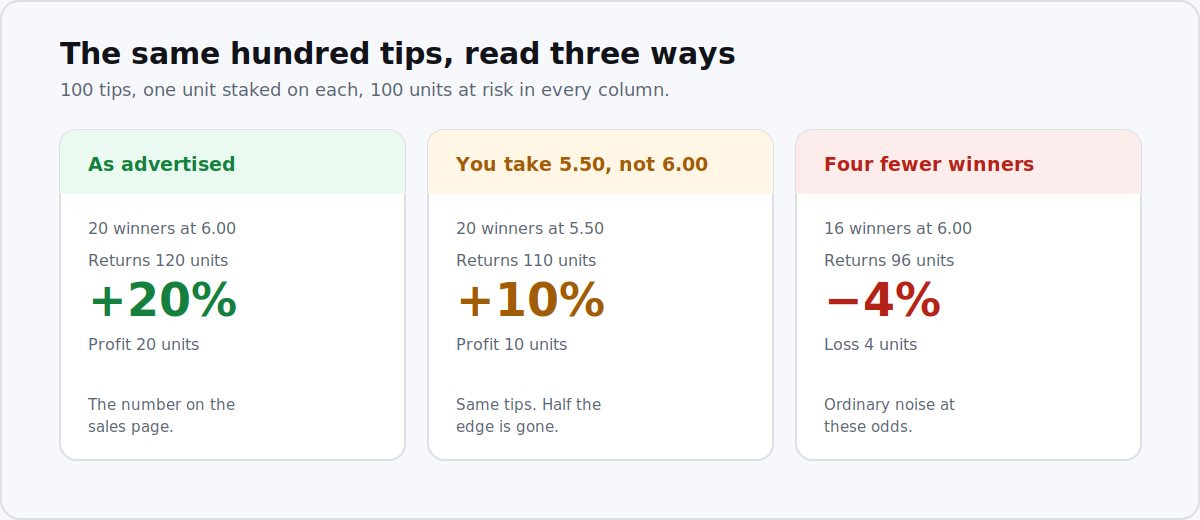
A tipster posts a hundred tips at average odds of 6.00, one unit staked on each. Twenty win, returning 120 units, so the profit is 20 units and the ROI is 20%. Remove four winners and sixteen wins return 96 units, leaving you 4 units down.
Four results in a hundred separate a star service from a losing one. At odds of 6.00 that swing is ordinary noise, not skill.
So read the number of tips before the ROI. A hundred settled bets is a small sample. A thousand starts to be useful, and long odds need far more than short ones.
What a believable ROI looks like
Once you know the sample is large enough, the next question is whether the ROI is plausible at all.
The two figures move against each other. A service backing long shots runs a low strike rate. A long-term ROI of 20% to 30% there is strong but possible. A service backing short prices runs a high strike rate, and its ROI will usually sit in low single figures. Anything above 40% across thousands of settled bets is a red flag rather than a recommendation. That level beats what full-time professionals sustain.
So compare the claim against the style of betting behind it. A 30% ROI at average odds of 1.50 is not impressive, it is implausible.
Two ticks of price can erase the whole edge
Every tip is recorded at the advised odds, the price that existed somewhere at that moment. Your result depends on whether you can still get it. Serious platforms also store the closing odds, so you can see whether the market moved with the tip or against it.
Take the same example. The record says 6.00 but you take 5.50, so twenty winners return 110 units instead of 120. The profit halves to 10 units.
The effect is sharper at short prices. A service running at average odds of 1.77 with a 3.33% yield loses its whole edge once the price drifts to about 1.71. That is a few steps on most odds ladders. You followed every tip correctly and the price did the damage on its own. A popular tipster is harder to follow than a quiet one, because a public tip moves the market within minutes.
Our odds converter helps if your bookmaker shows a different format from the record.
Check what the card is measuring
Under every set of figures sits a small grey line naming the period. Almost nobody reads it.
Some cards cover everything since the tipster joined, which can run to years. Others cover form over the last three, six or twelve months. Both styles appear on the same platforms, sometimes on the same page.
A three-month window catches a hot run. A long window includes the bad spell that came before it. Put two services on the same period before you compare them, then count the tips inside that period.
Profit and price belong on the same line
Many platforms print an average monthly profit, usually in points against a stated betting bank, right next to the subscription price. Reading the two together is the most useful thing you can do in ten seconds.
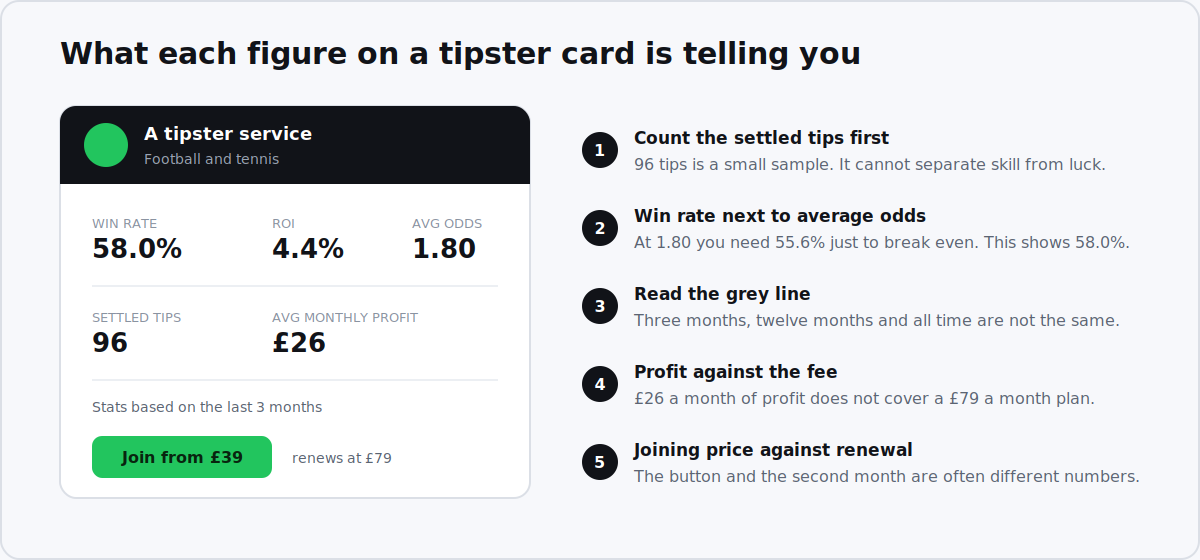
The gap can be uncomfortable. On one platform that prices in pounds, a featured service showed about £5 of average monthly profit against a £39 renewal. Another showed £26 against £79. Both figures came from the platform itself.
The trap is that they do not move together. The profit figure is measured at the stakes the record assumes, while the fee is fixed. Turning £26 into more than £79 means staking at least three times what the record assumes. A bad month then runs three times deeper.
Work out the stake that makes a subscription worth paying before you pay it. If that stake is larger than your normal bet, the service is not priced for you.
Our staking guide covers how to size that against a bankroll rather than a hope.
Where the profit sits inside the record
A headline ROI is an average, and averages hide the thing you need.
Good platforms break a record down by bookmaker, by odds band and sometimes by the maximum bet the market accepted. You will often find the profit sitting with one bookmaker while another is deep in the red over a similar number of tips. Ask whether you hold an account there and whether it will still take a normal stake. A record built at a bookmaker closed to you is not available to you.
Odds bands work the same way: a tipster can be strong at 2.00 and hopeless at 8.00, and one number covers both. Where the average maximum bet is shown, read it as a warning about size. Our bookmakers page is worth ten minutes before you open an account anywhere.
Automatic settlement is not the same as proof
The word appears on every tipster platform and it does not mean the same thing twice.
At its strongest it means two things. The tip carries a timestamp from before the event, with the advised odds attached. The result is then settled automatically from a data feed. The tipster cannot go back and change either. That is a real protection and it rules out the most common fraud, which is deleting the losses.
What it does not cover is larger. Nobody placed the bet, and no money moved. The platforms say so in their own terms, where the published figures are described as models built from stored prices, not as statements of anyone's account.
Apps where you type the result yourself are weaker still. Testing one tracker, we marked a match that had not started as won. The dashboard booked the profit straight away and moved the win rate with it. That is written up in our mybets.gg review.
A verified record proves the tip existed at that price. It does not prove a person profited from it.
There is one more gap worth knowing about. Where a tip is priced on a betting exchange, the advised price may never have been matched by anyone. If the selection then wins, a careless record still logs a winner. No money could have been placed at that price. Ask how a service handles unmatched bets. The honest answer treats them the same way whether the result was good or bad.
So use proofing as a filter. It removes the people who edit their history and leaves you the harder job of judging skill.
One account can run many services
Marketplaces let anyone open a tipster page, and the limits are looser than most readers assume. One platform's terms allow a single account to hold up to thirty separate pages.
Nothing there breaks their rules. It does mean one person can run many services, wait to see which get lucky, and promote only those. So a short winning record from an unknown name is worth less than the same record from a page open for two years.
How to spot a fake tipster in five checks
Run them in this order.
Count the settled tips in the period on screen, not the period the headline suggests. Read the strike rate next to the average odds rather than alone. Open the bookmaker breakdown and find where the profit actually sits. Compare the published monthly profit with the monthly fee at your own stake. Then check whether the tipster service tells you the price it took, so you can compare it with the price you can get.
Test it for a month without paying
Every check above uses the platform's own numbers. This last one uses yours instead, and it is free.
Follow the service on paper for a month. This is called paper trading, and it costs nothing but attention. Write down every tip, the price it quotes, the price available to you at that moment, and your own settled result. Use the same stake for every entry, one point or one unit, so the totals stay comparable.
After a month you can answer two questions for yourself. Were the quoted prices reachable from your own account, and does your settled total match the published one? The size of the gap between them is your real answer.
A bet tracker does this for you if a spreadsheet feels like work.
What this section holds
Skilled tipsters exist. The trouble is that a lucky one and a skilled one look identical for months, and a sales page is built to blur that difference. The numbers on a tipster page describe a price somebody else got, under a staking plan and a period somebody else chose. Your own results begin from there.
If your tips arrive in a chat rather than on a platform, the money behind them works differently. Our guide to Telegram betting channels covers that case. Reviews of individual platforms will be added below as we test them, each judged by the checks on this page.